From Conceptual Framework to Academic Forum: Gestaltango Presented at the 26th Panhellenic Conference of Physical Education & Sport
26th Panhellenic Conference Physical Education Sport, Argentine Tango research, Gestalt theory, Gestaltango, Greek academic conferences, Pavlos Mavromatis, Tango Secrets, Thessaloniki Greece, dance and cognition, educational movement research, embodied learning frameworks, embodied movement, interdisciplinary movement studies, movement science Greece, movement-based education, physical education conference Thessaloniki, relational awareness, tango academia Greece, tango and psychology, tango pedagogy research
Thessaloniki, Greece • 13–14 December 2025
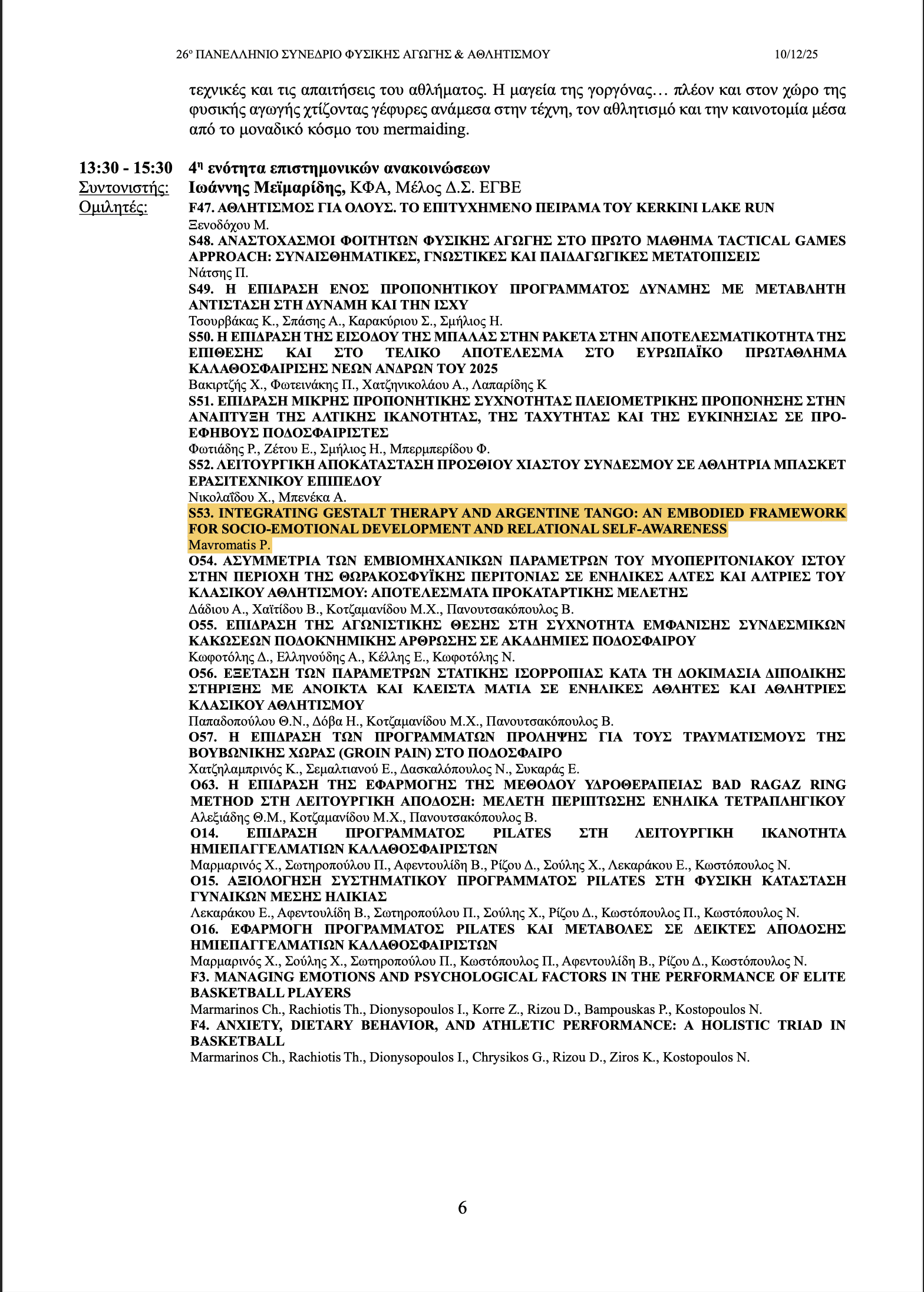
The research framework known as Gestaltango was presented for the first time in a complete professional academic setting during the 26th Panhellenic Conference of Physical Education & Sport, held on 13–14 December 2025 in Thessaloniki (download full program). Its creator Pavlos Mavromatis made the presentation.
This presentation marked a decisive transition: from initial public articulation to formal academic engagement, situating the research within a nationally recognized scientific forum dedicated to physical education, sport science, movement studies, and embodied research.
Pavlos Mavromatis is an international tango dancer, educator, and coach with over two decades of experience in teaching, performing, and researching tango practices worldwide. He is a trainee in Gestalt Therapy and an independent researcher with a focused interest in Gestalt-based phenomenology, relational processes, and embodied awareness. Drawing on sustained engagement with Gestalt theory, he has systematically adapted selected Gestalt principles into tango-based pedagogical frameworks, emphasizing presence, embodied perception, dialogical interaction, and mindful partner communication. His approach has evolved through longitudinal teaching practice, structured observation, and iterative experimentation across both group and individual learning contexts, integrating dance pedagogy with insights from psychology, embodiment studies, and relational dynamics.
A National Scientific Context
The Panhellenic Conference of Physical Education & Sport constitutes one of the most established academic gatherings in Greece for scholars, researchers, educators, and professionals working in the fields of movement, physical education, sport, health, and pedagogy.
Its 26th edition brought together academics and practitioners from universities, research institutions, and professional bodies, offering a peer-oriented environment grounded in scientific rigor, methodological awareness, and interdisciplinary dialogue.
Within this context, the presentation of Gestaltango took place not as an introductory talk or demonstration, but as a research-based contribution addressed to a fully professional academic audience.
The First Complete Academic Presentation of the Research
While Gestaltango had previously been introduced in public and educational contexts, the presentation at the 26th Panhellenic Conference represents the first complete academic articulation of the research framework.
This distinction is essential.
The conference presentation positioned Gestaltango:
• within scientific discourse
• in dialogue with movement science and embodied education
• under the expectations of academic clarity, ethical boundaries, and conceptual precision
It marked the moment where the research entered formal scholarly space.
Research Focus and Interdisciplinary Orientation
Gestaltango is a research-informed framework grounded in published scientific data, emerging at the intersection of:
• Gestalt Therapy
• Argentine Tango
• embodied cognition
• relational awareness and movement-based interaction
The research explores how tango, understood as a relational and embodied practice, can function as a field of awareness, where movement, contact, and presence generate meaningful experiential data.
The framework addresses questions relevant to:
• physical education
• movement pedagogy
• embodied learning
• relational dynamics in motion
without reducing tango to choreography or metaphor.
Ethical and Conceptual Boundaries
A central element of the academic presentation was the clear definition of scope.
Gestaltango was explicitly positioned as:
• not a therapy
• not a therapeutic method (yet)
• not a clinical intervention (yet)
Instead, it was presented as a conceptual and applied framework that may function as part of broader educational, relational, or therapeutic processes, while respecting disciplinary boundaries and ethical distinctions.
This clarification is not ancillary; it is foundational to the research’s academic credibility.
Significance of the Academic Milestone
The presentation of Gestaltango at a national scientific conference signifies:
• entry into peer academic dialogue
• readiness for critical engagement
• alignment with research ethics and scholarly standards
• contribution to the expanding field of embodied and movement-based studies
It also reflects a broader shift in tango-related research: from experiential narratives toward methodologically conscious, interdisciplinary frameworks.
Institutional Anchoring and Verification
The presentation was formally included in the official analytical program of the 26th Panhellenic Conference of Physical Education & Sport, reinforcing its institutional legitimacy and public traceability.
The full conference program is publicly available and documents the academic context in which the research was presented.
Research Continuity and Outlook
This academic presentation does not mark the conclusion of the research, but a continuation at a higher level of scholarly engagement.
Gestaltango remains an open and evolving framework, intended to develop further through:
• research dissemination
• academic discussion
• interdisciplinary collaboration
Future presentations and publications will continue to refine its conceptual clarity and academic contribution.
Conclusion
The first full academic presentation of Gestaltango at the 26th Panhellenic Conference of Physical Education & Sport in Thessaloniki represents a clear moment of transition, from public articulation to formal academic presence.
It affirms a commitment to:
• scientific responsibility
• ethical precision
• interdisciplinary dialogue
and situates the research within the broader landscape of movement, education, and embodied inquiry.